
Air filter foam.
Open-cell polyether polyurethane, reticulated so air passes with very little resistance. Cut to size or die-cut to profile, 20 to 80 PPI, from 5 mm thickness, washable rather than disposable.
What air filter foam is.
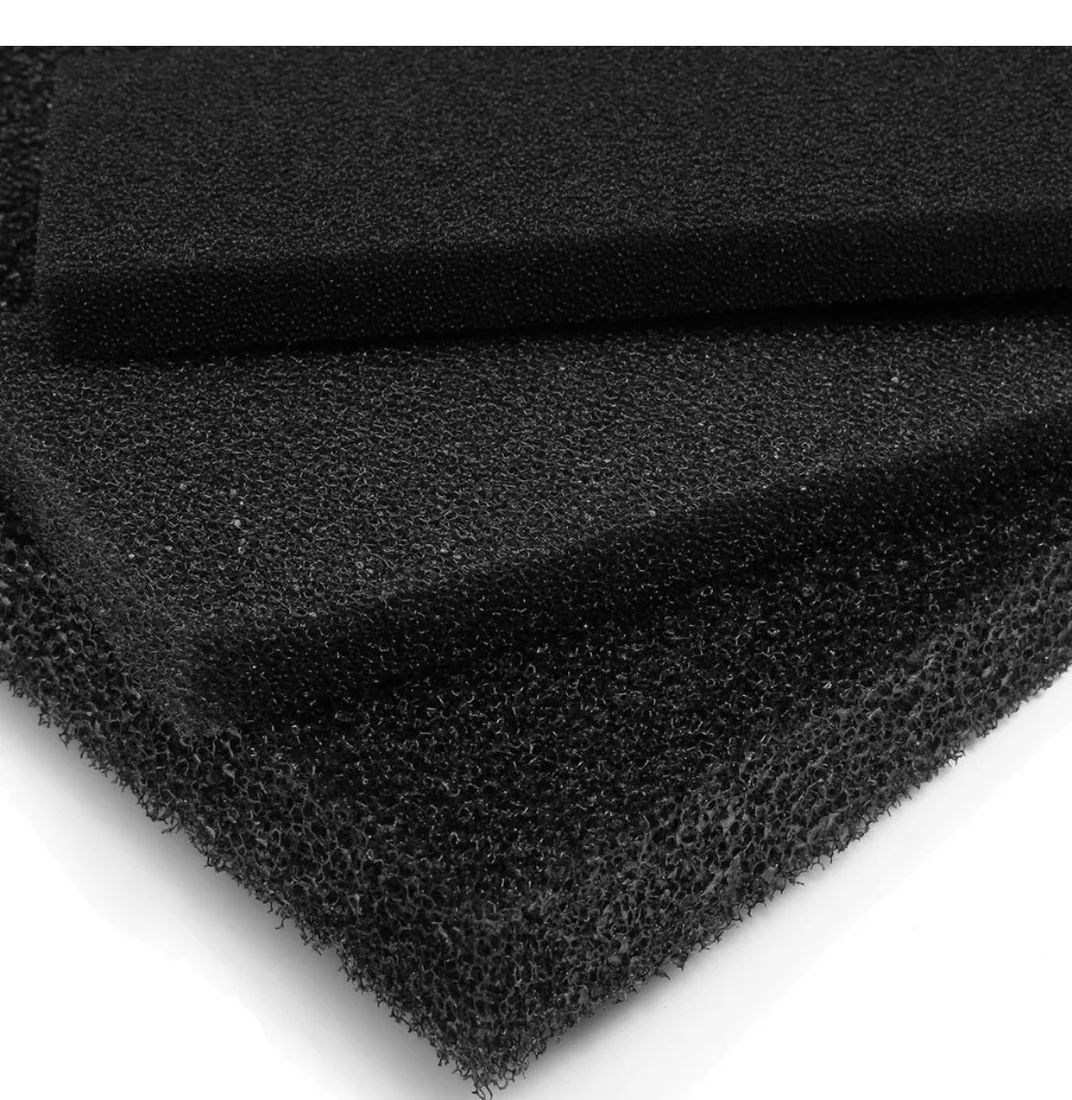
Air filter foam is polyurethane in an open-cell structure that has then been reticulated: the thin membranes between cells removed, leaving only a lattice of strands. That last step is what separates filter foam from upholstery foam. Both are open-cell; only the reticulated one lets air through without a fight.
For air duties the chemistry is polyether rather than polyester. Polyether resists humidity well, and air filters live in moving air of unpredictable moisture content — exactly the condition under which polyester foam breaks down over time. See polyester against polyether for the full comparison.
Standard supply is black, and that is functional rather than cosmetic: carbon pigment gives real resistance to ultraviolet light, which is the main thing that embrittles polyurethane. For any filter that sees daylight, black materially outlasts a pale foam.
Three numbers on the order.
- Pore grade, in PPI. 20 to 80. Coarse flows and holds dirt; fine captures and clogs. See choosing a PPI.
- Thickness, from 5 mm. The most under-used variable — a thicker section at the same grade holds proportionally more dirt without adding much resistance.
- Profile. Cut to your frame, not trimmed on site. See die-cutting to your drawing.
If you are unsure of the grade, do not guess — describe what the equipment is, what it draws in and how often anyone will service the filter. That points to a specification faster than a catalogue does.
Applications we supply.
- HVAC and air handling — intake and pre-filter stages, condenser guards, evaporative coolers.
- Compressors and blowers — intake elements where pressure drop is an energy cost.
- Panels and cabinets — fan and louvre filters keeping dust off boards and terminals.
- Automotive and motorcycle — airbox and pod filter elements, single or dual stage.
- Acoustic grilles — dust protection for drivers without dulling output.
- Spray booths — intake filtration where airborne dust would land in wet paint.
Common questions.
What is air filter foam made of?
Polyurethane, in an open-cell structure that has then been reticulated — the membranes between cells removed so only a lattice of strands remains. For air filtration the polyether type is standard, because it resists humidity well. Polyester foam exists and is used where a rougher strand surface helps hold liquid, but for air it is usually the wrong choice. See our comparison of polyester against polyether foam.
Is foam better than paper for an air filter?
For different things. Paper achieves finer capture and is the right answer where a certified filtration grade is required. Foam flows more freely, holds far more dirt before it restricts anything, and can be washed rather than replaced — so it wins on pre-filtration, dusty environments and total cost of ownership. In many systems the best answer is both, with foam in front.
Can air filter foam be cut to size?
Yes, and it should be. We supply it die-cut to your profile rather than as sheet for somebody to trim on site, because a hand-trimmed element leaks around its edges and the bypass undoes the filtration. Send the frame dimensions, a drawing, or the old filter.
What colour is air filter foam?
Standard supply is black. It is not cosmetic — carbon pigment gives real resistance to ultraviolet light, which is the main thing that embrittles polyurethane over time. For a filter sitting anywhere near daylight, black materially outlasts a lighter foam.
How thick should air filter foam be?
From 5 mm upwards, and thickness is more useful than most people realise. A thicker section at the same pore grade holds proportionally more dirt without adding much initial resistance, so it often beats going to a finer grade. 10, 20 and 30 mm are the most commonly ordered.
Keep reading.
Ready to bring
your idea to life?
Whether you're an entrepreneur with a sketch or an established company scaling production, we'll treat your project like it's the only one on the floor.
Let's talk.
Prefer a quick chat? Call us directly, ping us on WhatsApp, or drop an email. We reply within a few hours during business hours.